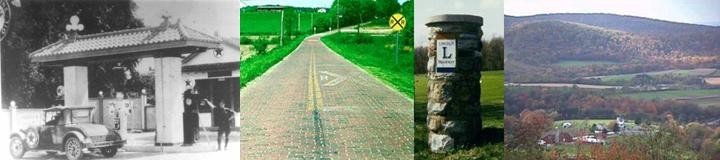
BEAUTIFICATION OF THE LINCOLN HIGHWAY
As presented by Esther M. Oyster to the Mid-Ohio Lincoln Highway Association.
From the very beginning of the Lincoln Highway, beautification
was an integral part of the planning. The concept for a memorial highway was
based on the Apian Way that led to Rome, a road once adorned with beautiful
monuments, magnificent temples and large villas with beautiful gardens, and even
though the Founding Fathers of the Lincoln Way knew the roadside enhancements
would not endure over the centuries, still they wanted their new highway to be
unique and beautiful.
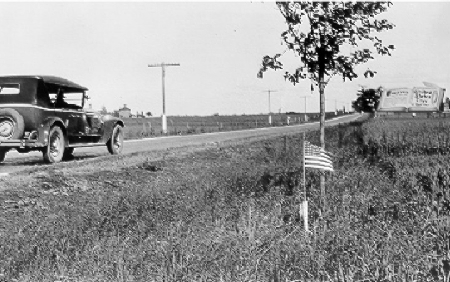 Photo used with permission from the Lincoln Highway Collection,
Transportation History Collection, Special Collections Library, University of
Michigan
Photo used with permission from the Lincoln Highway Collection,
Transportation History Collection, Special Collections Library, University of
Michigan
Even before the Lincoln Highway, when some of these same men were promoting the
Lincoln Memorial Road to run from the White House to Gettysburg, their vision
called for a 200-ft. right-of-way with a 40-ft. green sward in the center, which
would be a well-kept lawn resembling a beautiful carpet of velvet, interspersed
with flower gardens and other decorative features, such as fountains and
monuments. On either side of the median would be double-width concrete roadway,
both for 2-way traffic, one for swift-moving vehicles-automobiles--, and one for
the slower, horse-drawn vehicles. Bordering the road on either side would be
stately trees, the rows broken at points to offer views of spectacular scenery.
When the Lincoln Memorial Road did not materialize, the men brought this
perspective of beautification to the Lincoln Way, and included it as one of
their key points. They continued to promote it over the years, including annual
progress reports, and they had special plans for beautifying the Ideal Section
in Indiana. Jens Jensen of Chicago, a landscape architect, was a member of the
planning committee for the Ideal Section.
Beautification can consist of various elements. Normally we think of
landscaping, especially the planting of trees, but it can incorporate elements
of the road itself, such as the design of a bridge, or roadside utilitarian
services, such as signage, fountains and benches.
Primarily this paper will deal with the landscaping projects that were
instigated, and these were carried out in most part by the General Federation of
Women's Clubs, which set up a special Conservation & Lincoln Highway Tree
Planting committee, with Mrs. E. E. Kendall as chairman. They worked, then, with
the local clubs in each community. Of course, some areas had their own natural
beauty which didn't need enhancement, such as the mountains of Pennsylvania and
at the Nevada-California border in the regions of Lake Tahoe and Donner Pass.
Who could improve upon such scenery? As far as unusual roadside architecture, if
ever a building called out for restoration, it is Noah's Ark east of Bedford,
Pennsylvania. How nice it would be if it were restored to its original
configuration as the Ship Hotel!
Referring to the early Bulletins issued weekly by the Association to Officers
and Directors, I found these references to beautification:
1914
January 15, New Jersey: Officials of the Newark Motor Club plan to plant trees
and shrubbery on Arbor Day along the old Plank Road, now the Lincoln Highway,
between Newark and Jersey City.
February 2, Ohio: Professor Lazenby, head of the Ohio Forestry Assn., has been
appointed member of a committee to look after the planting of native "Buckeye"
trees along the Lincoln Highway in Ohio.
March 2, Illinois: Professor Wilhelm Miller of the University of Illinois will
be in Detroit on March 15 and will deliver an address on the general plan to
beautify the Lincoln Highway through landscape gardening. (Note: This report has
not been located in the archives.)
March 16, Illinois: Charles Gurier of De Kalb has contributed 2,000 6-ft. elm
trees to be placed along the Lincoln Way on Arbor Day. The trees are to be
planted by school children under the direction of the Women's Club. Each one of
the public and parochial schools have an area of the route assigned to them.
May 4, Ohio: The Business Men's Assn. of Lisbon has contributed 25 trees to the
Lincoln Highway Assn., and these were planted along the Lincoln Way on Arbor
Day.
May 26, Illinois: Mrs. Kendall, chairman of the Conservation & Lincoln Highway
Tree Planting Committee, will distribute Lincoln Highway literature to every
delegate attending the Biennial Conference in Chicago in June, and she will
deliver an educational talk to the estimated 2,500 delegates on the subject of
the highway and the plans of the Federation for beautifying it. The General
Federation is also interesting the Daughters of the American Revolution, State
Granges, Michigan Audubon Society, Women's Rivers & Harbors Congress, State
Teachers Associations, and the University of Michigan in the project
1915
April 23, California: The various Women's Clubs of Stockton, in addition to
cleaning up and beautifying the city, have arranged to beautify the entrances as
well. Vines have been planted so that they will grow over the bridge which
crosses the canal, and the banks of the canal have been planted with seeds.
Same date, Illinois: Mooseheart Manager Rodney Brandon is planning on
beautifying the Lincoln Highway from Aurora to Batavia with shrubs from the
Mooseheart Forestry Department. It is expected that the shrubs will be planted
next month.
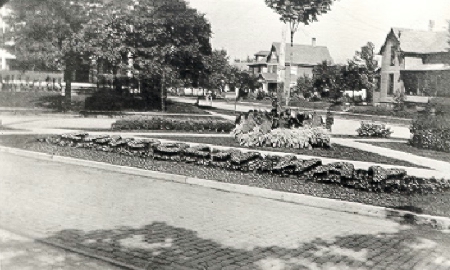
May 7, Ohio: The first Lincoln Highway tree to be planted in Bucyrus, a fine
maple, was planted by a committee of the Women's Club recently. From time to
time, additional trees will be planted along the route through the city, in
accordance with the plan which is being worked out by the women's clubs all
along the Lincoln Highway.
June 12, Pennsylvania: The Chambersburg newspaper, The Register, protested
against the painting of advertising signs on barns and fences along the Lincoln
Way, as introducing an incongruous note in the beautiful scenery of that region.
The paper stated that having the homes, barns and fences painted in lurid colors
with advertisements of whiskey and patent medicine is not the best way to make a
good impression upon tourists.
 Bucyrus, Ohio. Photo used with permission from the Lincoln Highway
Collection, Transportation History Collection, Special Collections Library,
University of Michigan
Bucyrus, Ohio. Photo used with permission from the Lincoln Highway
Collection, Transportation History Collection, Special Collections Library,
University of Michigan
Same date, Ohio: On one of the beautiful streets which forms part of the Lincoln
Way through Bucyrus, a long flower bed has been planted, and the words "LINCOLN
HIGHWAY" formed in brilliant blossoms against a background of green.
Same date, Nebraska: A movement to have boxes of flowers in the windows of Omaha
business houses on the Lincoln Way has been started. Omaha wants her Lincoln Way
to be a credit to the city.
August 31, California: Trees have been planted along the Lincoln Way between
Auburn and Loomis. These trees are placed at intervals of about 50 ft. and will,
in the course of time, make this section of the Lincoln Highway one of the most
beautiful, as well as one of the most perfect, sections of the transcontinental
road. Nothing so pleases the eastern tourist as to drive for miles on an avenue
with stately palm trees arching overhead.
1916
April 22, New Jersey: The State Federation of Women's Clubs has a Lincoln
Highway Conservation Dept., headed by Mrs. W. M. Wauters, who is especially
active, and who has secured the presence of Pres. Wilson and Gov. Fielder in
Princeton on April 25th for the planting of a Lincoln Highway tree. The
Association was furnishing special gold membership pins for the two dignitaries.
The event was to be covered by Pathe Weekly of Jersey City and the Associated
Press.
August 26, Pennsylvania: The W. H. Moon Co. of Morrisville, one of the largest
landscape gardening and horticultural organizations in the East, advised that
they would contribute the labor and sufficient material from their nurseries to
plant a mile of Lincoln Highway between Trenton and Morrisville, in accordance
with the plan worked out by Prof. Wilhelm Miller, late Professor of Landscape
Gardening at the University of Illinois. The goal was to produce a mile of
Lincoln Way in eastern Pennsylvania that would embody the ideal plan for the
beautification of the entire route.
Researching local Ohio papers produced some additional information.
Ashland paper, April 22, 1914: Mrs. Bessie E. Moore was appointed chairman by
Ken Motor Monthly magazine of Cleveland to work with the women's study clubs and
other local societies for the beautification of the Lincoln Highway in Ashland
County. (Note: This pre-dates the involvement of the General Federation of
Women's Clubs by a month or two.) The study clubs promptly formed The Women's
Lincoln Highway Association. As plans evolved, they included the planting of
trees, the designation of historical places associated with famous people who
had lived in the county at one time1, the erection of vine-covered
arches at county boundaries, and the erection of two drinking fountains on
roadside springs.
In connection with the planting of trees, this little verse appeared with the
article:
Plant a tree along the roadside,
Plant a dozen if you can,
For yourself and for your children
And your weary fellow-man.
By August they were working in connection with the General
Federation of Women's Clubs, and were lining the highway with trees, shrubs and
flowers. Quoting the article of August 7, 1914: "Cool bubbling springs are found
along the road, and drinking fountains will be placed where the weary traveler
can quench his thirst and take away with him pleasant memories of this part of
his journey. It is proposed to plant tall shade trees where the road is
straight; where it is winding, fruit trees will be used.
"In the spring, transcontinental tourists will be winding through lanes of
arching apple blossoms, and in the fall the luscious fruit can be picked without
the traveler leaving his machine."
From the Bucyrus Journal of May 6, 1921, there was an follow-up item about the
Memorial Elms that had been planted along the Lincoln Way at the end of WW I to
commemorate the young men of Crawford County who had been killed in the war. In
the current project they were replacing trees that had not done well, and were
repainting the name tablets. The trees, spaced 200 ft. apart, had been planted
by the Manufacturers Association, under the supervision of Local Consul E. J.
Songer.
Beautification is one of the items discussed in the annual Progress Reports
issued by the Association.
1914, from THE LINCOLN HIGHWAY TODAY: SUMMARIZING A YEAR'S SUCCESS:
Pg. 9: In many of the towns and cities along the route the authorities or the
people have erected arches or welcoming signs at the entrances of the Way into
the city. This has been done in Chambersburg, Lancaster and York, Pennsylvania;
South Bend, Elkhart and Goshen, Indiana; Ashland, Bucyrus and Canton in Ohio;
and Omaha, Nebraska. A large steel arch is in the process of construction at
Fort Wayne, Indiana. Others have been proposed.
Pg. 11: The American Institute of Architects, through its President, R. Clipston
Sturgis, has offered its cordial cooperation in the preparation of designs for
arches, tablets, memorials and bridges to be erected along the Lincoln Way.
Their offer of assistance has been accepted as being of inestimable value in
teaching the lesson of good taste, and in assuring to the Lincoln Highway the
most beautiful work and mature ideas of the leaders of the architectural
profession in this country. Through the cooperation of the Institute, wealthy
patriots who desire to perpetuate the name of their families or of some loved
one, can be sure of the most beautiful and lasting, as well as useful, monument
by building on the Lincoln Way a bridge, an arch or a simple memorial tablet.
1915, A RECORD OF CONSISTENT PROGRESS, pg. 10:
California's concrete bridges impressively prove that to be useful, they need
not be ugly and distasteful structures. The artistic bridge on the Lincoln
Highway leading into Sacramento2 is an instance of this. Here is a
Lincoln Highway bridge par-excellence, with the dignity of a public structure.
The sweeping curves of its classic lines add to the beauty of the landscape. No
tourist enters Sacramento without commenting upon the beauty of this structure,
which should be a model for bridges all along the line of the transcontinental
road. Unquestionably the future will see every dingy, rusty, criss-cross of
structural steel now serving as a bridge replaced with a work of art and beauty,
such as this which graces California, and leads the tourists appropriately onto
a concrete boulevard between overhanging rows of stately palms.
Mike Buettner was given this poem about the Lincoln Highway which appeared in
the 1915 Gomer School (Ohio) Year Book, author unknown; the second verse is
especially relevant to the topic:
We read in the ancient chronicles
Of the Appian Way of old,
Built by the Roman Appius,
So the historians have told;
But a far grander achievement
Undertaken by America today
Is building from ocean to ocean
What is know as the Lincoln Highway.
'Tis not built for utility only,
But for its beauty as well;
Trees planted along its borders,
Where the little songsters may dwell.
May dwell here and sing unmolested,
Nests build and happily stay,
For no gun may be fired by a hunter
Along the great Lincoln Highway.
So when we grow weary of farming,
And when we grow weary of chores,
We think of the mighty Atlantic,
And Pacific's beautiful shores;
We'll throw our cares to the east wind,
Forget the trials of the day,
And with our staff and our knapsack,
We'll take to the Lincoln Highway
It has now been 85 years since the beautification of the Lincoln
way was undertaken, and, sad to say, most of the trees, beautiful concrete
bridges and roadside architectural amenities no longer exist. From the few
remaining roadside artifacts, one can envision the Lincoln Way as it originally
existed. These items include the seated Lincoln statue in New Jersey; the
magnificent George Westinghouse bridge in Pittsburgh; the old pine trees within
the right-of-way in western Crawford County and the last two original brick
mile-marker pillars in Ohio; the Harrison Street bridge and the Ostermann
Memorial Bench in Indiana; the H. I. Lincoln building in Illinois; the Moss
markers and the few remaining Marsh Rainbow bridges in Iowa; the famous LINCOLN
HIGHWAY bridges in Tama Iowa and at a rest area in Nevada; the original brick
sections in Iowa and Nebraska; the large Lincoln memorial now along I-80 in
Wyoming and the beautiful concrete bridge near Donner Lake.
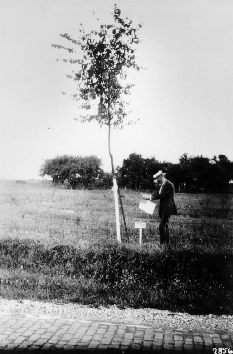 Photo used with permission from the Lincoln Highway Collection,
Transportation History Collection, Special Collections Library, University of
Michigan
Photo used with permission from the Lincoln Highway Collection,
Transportation History Collection, Special Collections Library, University of
Michigan
As our highways have become more streamlined with the interstate system, there
are no shade trees along the highway where the motorist may stop and rest in
cool shade, except for designated rest areas, nor can one reach up and pluck and
apple from a tree. I wonder; does the Lincoln Way still run through rows of
stately palms in California? I sincerely hope so.
(1) Monuments were erected to Johnny Appleseed in Ashland, and to the Studebaker
family at its homestead site five miles east of Ashland. A third one honoring
Sen. William B. Allison of Iowa was never erected.
(2) This bridge is pictured in the 1924 Guide, page 506, and appears to be in
the style of the Harrison Street bridge in Fort Wayne.